










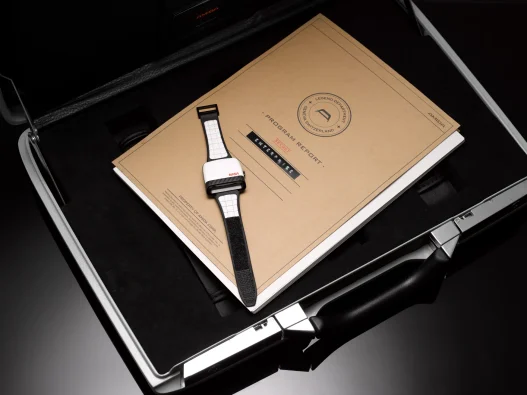

The 1970s was a wildly experimental decade for the horological landscape, but few designs captured the retro-futuristic zeitgeist quite like the original Amida Digitrend of 1976. With its distinct wedge shape and side-reading display, it was a watch that looked like it belonged on the dashboard of a spacecraft rather than a human wrist.

Fast forward to today, and that bold spirit of innovation has been spectacularly resurrected. Engineered to capture the unbridled ambition of an era when humanity dared to explore the cosmos, the brand has just released the highly anticipated AMIDA Digitrend NASA Tribute Watch.

Priced at £3400, this remarkable timepiece is a deeply passionate synthesis of pioneering aerospace history and forward-thinking independent watchmaking.
An Orbiter for the Wrist
To truly honor the legacy of the Space Transportation System (STS) and the Space Shuttle era, the design team had to look beyond standard watch geometries. The case architecture of the Digitrend NASA Tribute is a direct homage to the monumental engineering achievements of the space program. Measuring a compact 39.6mm wide by 39mm long, the watch is constructed from a black DLC-coated 316L stainless steel faceted metallic monobloc.

Engineered for maximum durability with minimal mass—the watch weighs in at just 90 grams—the case directly references the semi-monocoque structure of the iconic STS Orbiter. Capping off this stealthy black base is a brilliant white ceramic top shell, providing a striking, high-contrast visual dynamic.

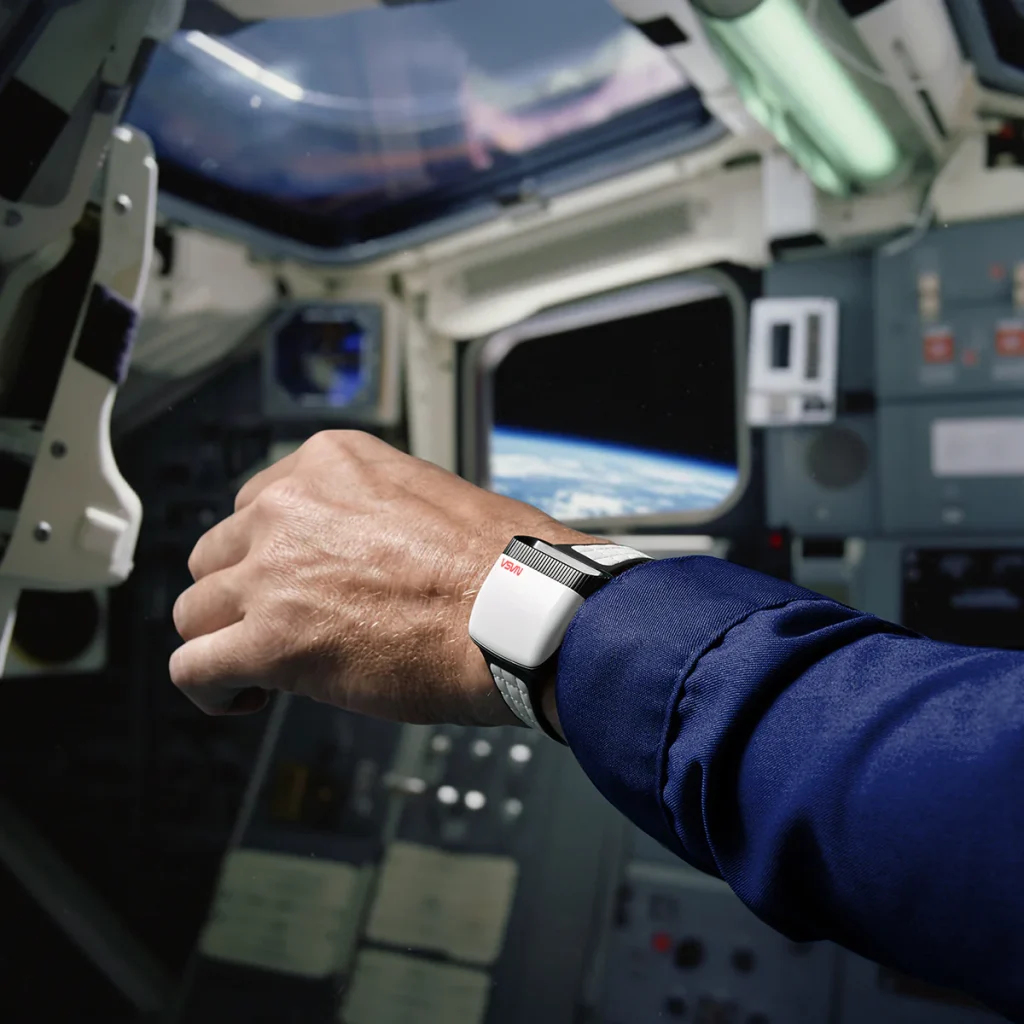
Proudly adorning the case is the legendary NASA “worm” logotype in bold red. Used by the agency from 1975 to 1992, this specific emblem perfectly anchors the timepiece in a modern, forward-looking era of cosmic exploration.
Prismatic Optics and Jumping Mechanics
While the exterior is a love letter to the Space Shuttle, the interior is a triumph of modern Swiss mechanics. The watch famously utilizes an optical display—often referred to as an LRD (Light Reflective Display)—which projects the dual hour and minute discs through a sapphire crystal reflective prism.

This allows the wearer to read the time seamlessly from the side of the wrist without turning their arm, a feature originally beloved by drivers but perfectly suited for the confined quarters of a cockpit.
Powering this fascinating digital display is a reliable Swiss-made Soprod Newton P092 automatic caliber, beating smoothly at 28,800 vph (4Hz) and offering a dependable 44-hour power reserve. However, the true mechanical star of the show is the proprietary auxiliary module.

The independent team at Amida developed a highly specialized, in-house jumping hour disc composed of nine precision mechanical components. This ensures the digital numerals snap perfectly into place, maintaining the crisp, instantaneous readout required by a true instrument watch.
Zero-Gravity Ergonomics
A watch dedicated to astronauts requires a strapping system that can handle the unique rigors of extraterrestrial travel. The AMIDA Digitrend NASA Tribute pays direct homage to the ingenuity of the space program’s equipment by utilizing a specialized bi-material strap. Crafted from a blend of premium leather and highly durable technical fabric, the strap tapers elegantly from 22mm at the lugs down to 18mm.

Most notably, it eschews a traditional pin buckle in favor of a robust hook-and-loop Velcro fastening system, neatly threaded through a black DLC satin-brushed steel loop.

This specific closure is directly inspired by its critical application for securing loose equipment and tethering astronauts in the zero-gravity environment of space, allowing for infinite micro-adjustments over a bulky flight suit or a bare wrist.

At £3400, this timepiece is far more than a simple novelty. It is a brilliant, highly capable piece of independent watchmaking dedicated to Amida’s path of bold ideas and clear function. By successfully merging complex optical displays with a heartfelt tribute to human exploration, the AMIDA Digitrend NASA Tribute Watch stands as a triumphant celebration of those who overcame immense adversity to reach for the stars.